Can you get a home loan on a B Khata property in Bangalore?
Can you get a home loan on a B-Khata property in Bangalore? Which lenders say no, why, and how B-Khata to A-Khata conversion changes the answer.
PropWatch Editorial7 min read
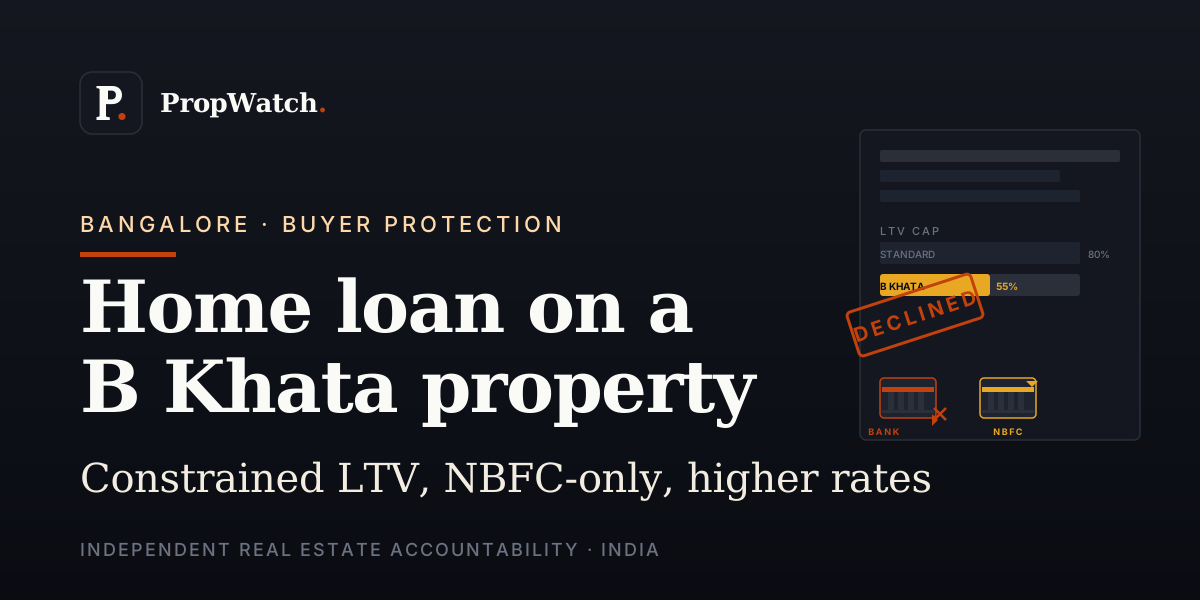
Walk into any scheduled commercial bank — SBI, Bank of Baroda, Canara, most private-sector banks — and ask for a home loan on a B Khata property in Bangalore. The answer is almost certainly no. The property does not meet the title and approval conditions that govern standard home loan underwriting. Some NBFCs and housing finance companies do lend, but the terms are meaningfully different from what you would get on an A Khata property. Before a buyer negotiates a price on a B Khata flat, understanding the financing landscape is not optional — it is the first step.
Why most banks decline B Khata properties
A bank lending against a property holds the property as security. If the borrower defaults, the bank must be able to enforce its charge, take possession, and realise value by selling the property. That process depends on clear title and legally compliant documentation. A B Khata property, by definition, has an unresolved municipal compliance deficiency — a missing layout approval, an absent DC conversion order, a building without sanctioned plans. Banks' internal credit policies and the RBI's prudential framework for housing finance treat such deficiencies as elevated risk.
The specific concern: if the bank's security is a property that could be subject to demolition, sealing, or regularisation proceedings, the collateral value is uncertain. Most scheduled commercial banks take the position that the uncertainty is not worth the loan fee — particularly when there is no shortage of A Khata properties to lend against.
Which lenders sometimes fund B Khata properties, and on what terms
Some housing finance companies (HFCs) and non-banking financial companies (NBFCs) have B Khata products or consider such applications on a case-by-case basis. The lenders whose names recur in this space include LIC Housing Finance, PNB Housing Finance, Indiabulls Housing Finance, CAN Fin Homes, and several cooperative banks. Whether a specific lender approves a specific application depends on the lender's current credit policy, the borrower's profile, and the specific deficiency underlying the B Khata status.
As of mid-2025, reported rates for B Khata home loans from these lenders ranged from approximately 9.5% (LIC Housing) to 14%, compared to sub-9% for standard A Khata home loans. Loan-to-value ratios were generally capped at 55% of assessed value — meaning a buyer needs to bring 45% or more as a down payment, compared to 20–25% for an A Khata property. These are market-reported figures; verify current rates and terms directly with any lender before relying on them.
What lenders typically require before approving a B Khata loan
- Clear land title — the underlying land title chain must be clean, even if the building approval is deficient. A lender will not advance against a property where the land title itself is disputed or encumbered.
- No tax arrears — all property tax dues to BBMP/GBA must be paid and receipts produced.
- Documented regularisation path — some lenders want evidence that the property is eligible for A Khata conversion, or that it sits in a category that is likely to be regularised under the applicable government scheme.
- Borrower credit profile — stricter income, employment, and credit-score requirements apply, as the property security is weaker than standard.
- Legal opinion — an in-house or empanelled advocate's opinion that the title and the specific B Khata deficiency do not present an unacceptable legal risk. Some lenders require this as a pre-sanction condition.
What a buyer carries when the lender is an NBFC
NBFC lending against B Khata properties shifts the risk profile in ways buyers sometimes miss. An NBFC's credit appetite is more flexible than a nationalised bank's, but its enforcement on default can also be faster — NBFCs can invoke the SARFAESI Act on default for loans above threshold, moving to possession and auction without a court order. If a borrower defaults on an A Khata home loan with SBI, the buyer faces NPA proceedings and an eventual enforcement process. The same default on an NBFC loan over a B Khata property can move through SARFAESI faster, and the auction value of a B Khata property in a forced sale is lower than for an equivalent A Khata property.
None of this means NBFC financing on a B Khata property is categorically wrong. It means the buyer should understand what they are entering. A B Khata property is a higher-cost, lower-LTV, more-restricted financing proposition than its price might suggest at first comparison.
Valuation and the gap between market price and lender value
Lender-commissioned property valuers typically apply a discount to B Khata properties relative to comparable A Khata properties in the same area. The discount reflects the compliance deficiency, the constrained buyer pool on resale, and the uncertain regularisation timeline. A seller pricing a B Khata property close to the A Khata rate in the same building or locality is pricing out the risk premium that both the market and lenders already embed. A buyer who pays A Khata prices for a B Khata property is absorbing that risk at no discount.
What to check before relying on B Khata financing
- Verify independently that any lender quoted by a broker or developer actually has a current product for B Khata properties — credit policies change, and a lender who was lending against B Khata properties in 2023 may have tightened the policy since.
- Get the loan sanction in writing before paying any significant amount to the seller. A pre-approval or in-principle sanction letter, issued after the lender's initial property assessment, is the minimum.
- Confirm whether the specific property's B Khata deficiency is a conversion-eligible one or a structural one. A property on lake buffer land or government land cannot be converted and is unlikely to be financed by any responsible lender.
- Read the loan agreement's conditions: whether the lender can demand early repayment if A Khata conversion does not occur within a specified window, and what the consequences of conversion failure are.
For a full picture of what B Khata means and when conversion is feasible, read the foundational explainer on A Khata vs B Khata in Bangalore and the detailed post on the 2025 B-to-A Khata conversion window.
SourcePropWatch — What is A Khata and B Khata in Bangalore: the foundational difference
SourcePropWatch — B-Khata to A-Khata conversion in Bangalore: 2025 window, eligibility and cost
SourcePropWatch — Bangalore real estate legal & K-RERA report
More from Buyer Protection
Apartment association registration in Karnataka: which Act, and why most are registered wrong
Apartment association registration in Karnataka must be under the KAOA 1972, not the Societies or Co-operative Act. Here's the correct route — and the trap.
How to evaluate a real-estate investment: rental yield vs capital appreciation
How to evaluate a property investment: rental yield vs capital appreciation, the real numbers to run, and the costs buyers routinely forget.
Builder won't hand over the association or common areas? Your RERA remedies
If your builder won't form the association or hand over the common areas, RERA Sections 11 and 17 are on your side. Here are your remedies, step by step.