How to evaluate a real-estate investment: rental yield vs capital appreciation
How to evaluate a property investment: rental yield vs capital appreciation, the real numbers to run, and the costs buyers routinely forget.
PropWatch Editorial8 min read
Real estate delivers two types of financial return: income (rental yield) and growth (capital appreciation). Most buyers conflate the two, price them loosely, and end up with neither. The framework below is an evaluation tool — not a prediction and not a recommendation. What a piece of real estate is worth as an investment depends on facts specific to that property, that market, and your own financial situation.
Gross rental yield — the headline number
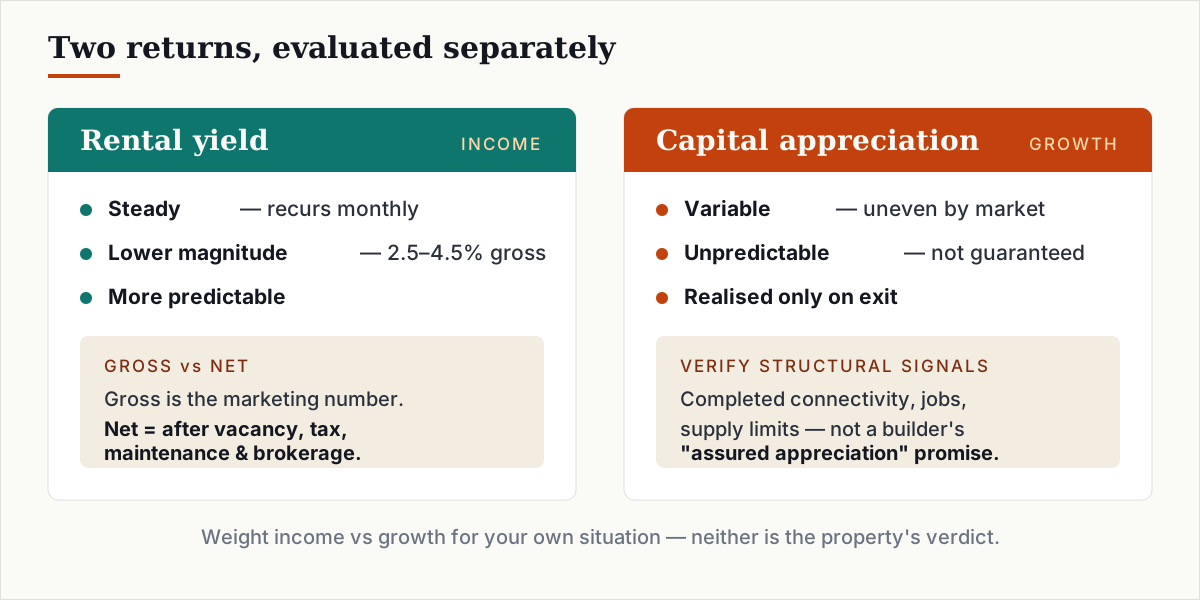
Gross rental yield is the simplest measure: annual rental income divided by the purchase price, expressed as a percentage. A flat purchased for ₹80 lakh that rents for ₹25,000 per month has a gross rental yield of 3.75 percent (₹3 lakh annual rent / ₹80 lakh). Market estimates for residential rental yields in major Indian metros generally range from 2.5 to 4.5 percent gross, depending on city, micro-market, and asset type, per property market data publishers such as Anarock and Knight Frank. These are market estimates, not guaranteed returns.
Gross yield is a starting point, not a decision number. It ignores everything that reduces the actual cash you receive.
Net rental yield — what you actually keep
Net yield deducts the costs of owning and running a rental property from the gross income. The main deductions: vacancy (the property sits empty between tenants — assume 4 to 8 weeks per year conservatively); annual property tax (varies by municipality and property size); maintenance and repair (typically 0.5 to 1 percent of property value annually); brokerage (one month's rent per placement is standard in most Indian cities); and, if the property is under a home loan, the interest cost on the outstanding principal.
On that same ₹80 lakh flat, realistic net yield after vacancy, tax, maintenance, and brokerage might be 2 to 3 percent. If the flat was purchased on an 80 percent loan at 9 percent interest, the debt cost alone significantly exceeds the rental income — the property is cash-flow negative. Negative cash flow is not inherently a problem if appreciation is expected to compensate, but it must be priced in, not ignored.
What drives capital appreciation — and what is speculation
Structural factors that have a documented relationship to residential price growth: improving physical connectivity (completed metro lines, operational road projects — not planned ones), job-market expansion in the locality, supply constraints (limited developable land, regulatory floor-area-ratio restrictions), and population growth in the catchment area. These are verifiable through government data, planning authority documents, and employment surveys.
Speculative factors that buyers routinely treat as structural: a builder's promise of 'assured appreciation', a sales agent's claim that a nearby IT park will drive prices up, comparisons to other micro-markets that are not comparable. None of these are durable investment theses. Capital appreciation in Indian residential markets is real but uneven: some micro-markets have compounded strongly over decade-long periods; others have been flat or negative in real terms for equal periods. Market data is backward-looking; future appreciation is not guaranteed by past performance.
The illiquidity premium
Real estate is illiquid. Converting a flat to cash takes 30 to 90 days in a normal market and longer in a slow one. Stamp duty and registration costs (typically 5 to 7 percent on purchase in most states) come off the return at entry. Brokerage (1 to 2 percent of sale value) comes off at exit. Income tax on capital gains — 12.5 percent for long-term gains under the current Finance Act rules, on the gain over the indexed cost — reduces net proceeds. These friction costs are not present in liquid alternatives like mutual funds.
A reasonable evaluation question is: what return, after all friction costs and holding costs, does this property need to generate over your intended holding period to compare favourably with a liquid alternative with a known expected return? If the property's projected return — which is uncertain — only marginally clears that bar, the illiquidity premium may not be worth it. This is not an argument against real estate ownership; it is an argument for being honest about the full cost stack before deciding.
What to actually check before buying for investment
- Current rental rates in the specific micro-market from active listings — not a sales agent's estimate, and not city-average figures
- Vacancy rates in the building or similar buildings nearby (ask a local broker, not the builder)
- Annual property tax applicable to the unit (available from the municipal body's online portal)
- Pending supply in the micro-market — RERA shows all registered projects under construction within a radius, which indicates future competition for tenants and buyers
- Distance and access to the actual employers in the area — not aspirational tech parks, but the ones currently operational and recruiting
More from Buyer Protection
TDS on a property purchase from a resident seller: Form 26QB, the 1% rule, and the mistakes that cost buyers
Buying from a resident seller? How Section 194IA TDS works: when the 1% applies, how to file Form 26QB, and the penalties for getting it wrong.
TDS on a property purchase (Section 194IA): the buyer's obligations, Form 26QB, and the NRI-seller trap
TDS on a property purchase under Section 194IA: the buyer's duty to deduct, how to file Form 26QB, and the higher-rate trap when the seller is an NRI.
Can you get a home loan on a B Khata property in Bangalore?
Can you get a home loan on a B-Khata property in Bangalore? Which lenders say no, why, and how B-Khata to A-Khata conversion changes the answer.