How to choose the right apartment in India: the buyer's checklist
A verification-first checklist for picking a flat — RERA status, OC, carpet area, builder track record, locality signals, payment schedule and title chain.
PropWatch Editorial8 min read

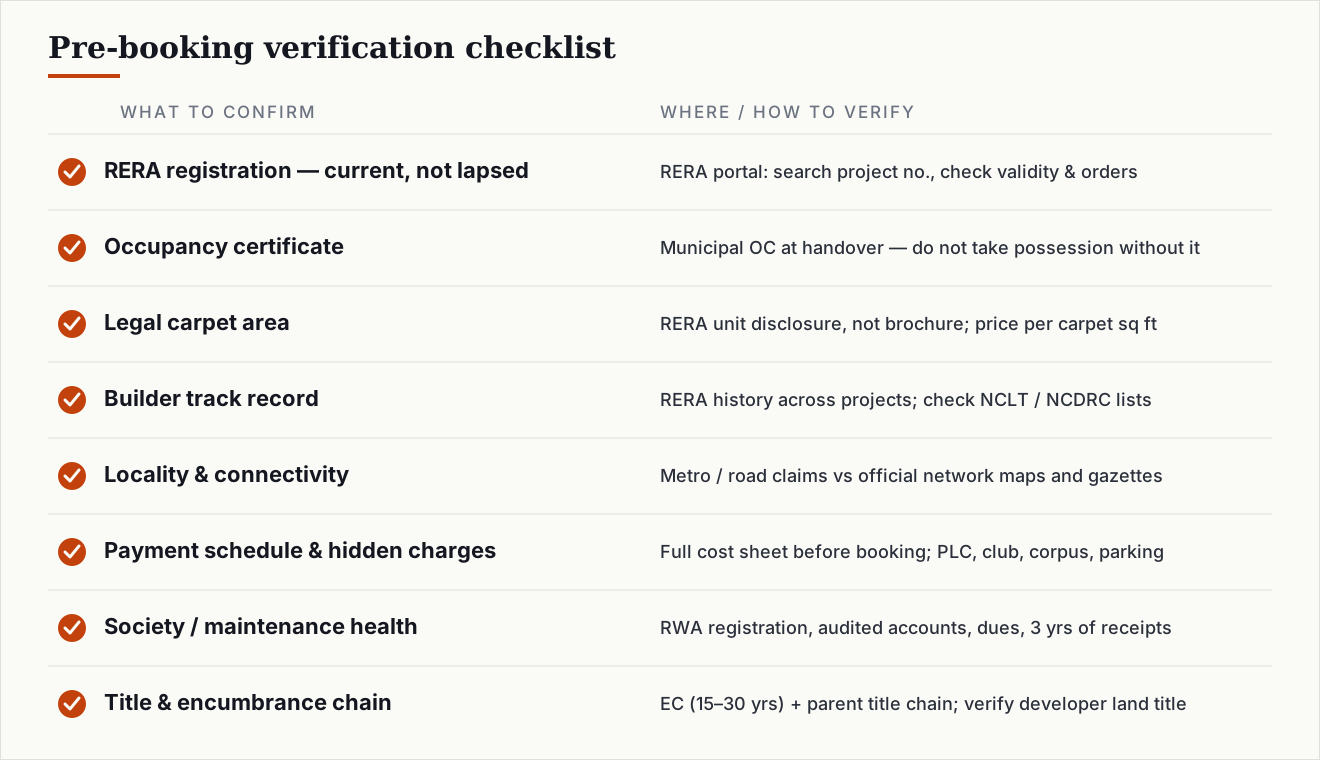
Most buyers spend more time comparing kitchen finishes than confirming the building has a valid occupancy certificate. That is the wrong order. Title defects, lapsed RERA registrations, and missing approvals are not disclosed on brochures — they surface months after registration, when reversing the transaction is costly and slow. The checklist below is a verification sequence, not a wishlist. Each item has a source you can check yourself.
1. RERA registration — current, not lapsed
Every project above eight units or 500 square metres of development area must carry a valid RERA registration under Section 3 of the RERA Act, 2016. 'Valid' means the registration has not expired. Builders routinely display a RERA number without mentioning the expiry date. On the relevant state portal — rera.karnataka.gov.in for Karnataka, maharera.maharashtra.gov.in for Maharashtra — search the project number and read the validity date and the complaints/orders tab. A pattern of refund orders or unfulfilled compliance notices on the complaints tab is documented track record. Read it before the brochure.
For a detailed walkthrough of this step, see our earlier post on verifying RERA registration. The short version: the portal record is authoritative; the brochure number is a starting point.
2. Occupancy certificate — do not take possession without it
The occupancy certificate is the municipal authority's confirmation that the building was constructed per the sanctioned plan and that fire, lift, water and sewage clearances are in order. Without it, the building is legally unoccupied, and property tax and electricity tariffs are typically assessed at penal rates. Banks routinely refuse resale home loans on buildings without OC, which constricts your exit options for years.
Section 17 of RERA requires the promoter to obtain the OC before handing over possession. A part-completion certificate or 'temporary OC' is not a substitute. If the builder cannot produce a final OC at the time of possession, do not sign the handover letter — or at minimum, document the outstanding status in writing with a firm deadline. We have covered the OC question separately; the core rule is: refuse possession without it.
3. Carpet area — what the RERA disclosure says, not what the brochure says
Under Section 2(k) of the RERA Act, carpet area is the only metric builders are legally required to disclose and charge for. It is the net usable floor area within the walls — excluding common areas, lobbies, shafts and amenity loading. The gap between advertised super-built-up area and actual carpet area can be 30 to 40 percent. A flat marketed at 1,200 sq ft super-built-up may have a carpet area of 780 sq ft.
Pull the carpet area from the RERA project disclosure on the state portal, not the brochure. Then divide the sale consideration by the carpet area to get the true per-square-foot price. A flat with lower super-built-up area but a tighter loading factor frequently offers more usable space per rupee. We cover the carpet-area calculation in detail in the companion post on carpet area vs super-built-up area.
4. Builder track record — public record, not sales-team claims
RERA portals are the most useful source of track-record data. Search the builder's name — not just the project — across all their registered projects on the portal. Look at possession date vs RERA completion date for previous projects. Check the complaints tab on each. If the builder has a history of possession delays and refund orders across multiple projects, that pattern will repeat; it is not unique to the difficult market cycle they are describing in their office.
Court filings are a secondary source. The National Company Law Tribunal cause list (nclt.gov.in) and the consumer forum orders available through the NCDRC portal record whether home-buyer complaints have escalated to NCLT or NCDRC level. A builder with ongoing NCLT proceedings related to home-buyer defaults is in a materially different risk category than one without.
5. Locality and connectivity — verifiable signals only
Sales teams describe every project as connected to the metro, near a major road, and minutes from an IT hub. Some of that is true; some is aspirational. The distinction matters. Verify the claimed infrastructure against official sources: metro station locations on the DMRC, Bangalore Metro, HMRL, or relevant agency's published network map; road widening notifications in official gazettes; approved development plans on the relevant planning authority's website.
Infrastructure projects routinely run five to ten years late. If the value case for a project depends on a metro station or flyover that is not yet under construction, price that uncertainty into your evaluation. The flat will be built and registered; the metro may not arrive on schedule.
6. Payment schedule and hidden charges
Construction-linked plans are safer for buyers than time-linked ones — you pay as slabs are completed and certified, which reduces the risk of paying for a project that stalls. Under RERA, the builder must declare the payment schedule in the project registration. Any charges not disclosed in the RERA registration are legally questionable. The charges to scrutinise: preferential location charges (PLC) for floor, view and corner units; club membership fees that are often non-optional; maintenance advance (corpus fund); and car-parking charges, which must be declared and cannot be charged separately under many state RERA interpretations.
Ask for the full cost sheet before signing the booking form, not after. A builder who is reluctant to provide a comprehensive cost sheet before you write a cheque is telling you something useful.
7. Society and maintenance health
For a resale flat in an existing society, check whether the residents' welfare association (RWA) or cooperative housing society is registered, whether the society's accounts are audited, and whether there are outstanding maintenance dues against the unit. Unregistered societies cannot enforce bylaws or hold common-area assets; the gap creates disputes that take years to resolve. Ask the seller for the last three years of society maintenance receipts and the society's meeting minutes if available.
8. Title and encumbrance chain
An encumbrance certificate (EC) from the Sub-Registrar's office records every transaction registered against the property — sales, mortgages, court attachments. A clean EC for the last 15 to 30 years is a necessary but not sufficient condition for clean title. The parent document chain — how the seller acquired the property, how the previous owner acquired it, and so on — must be verified separately for any mutation, partition, or conversion order that may not appear in the EC. For apartments in new projects, the developer's title to the land on which the project is built is the document to examine.
SourceNational Consumer Disputes Redressal Commission — order search portal
More from Red-Flag Guides
Carpet area vs super built-up area: what you are actually buying
Carpet area vs super built-up vs built-up area: what you actually own, how builders inflate the number, and what RERA now requires them to state.
Red flags in a property sales pitch: 8 claims to verify before you sign
Guaranteed returns, artificial scarcity, pre-launch without approvals — 8 generic claim types in property sales and exactly what to ask or check for each.
The occupancy certificate — what it is and why a buyer should refuse possession without it
What an occupancy certificate (OC) is, why a flat without one is a legal and safety risk, and why a buyer should refuse possession until it is issued.