Red flags in a property sales pitch: 8 claims to verify before you sign
Guaranteed returns, artificial scarcity, pre-launch without approvals — 8 generic claim types in property sales and exactly what to ask or check for each.
PropWatch Editorial7 min read

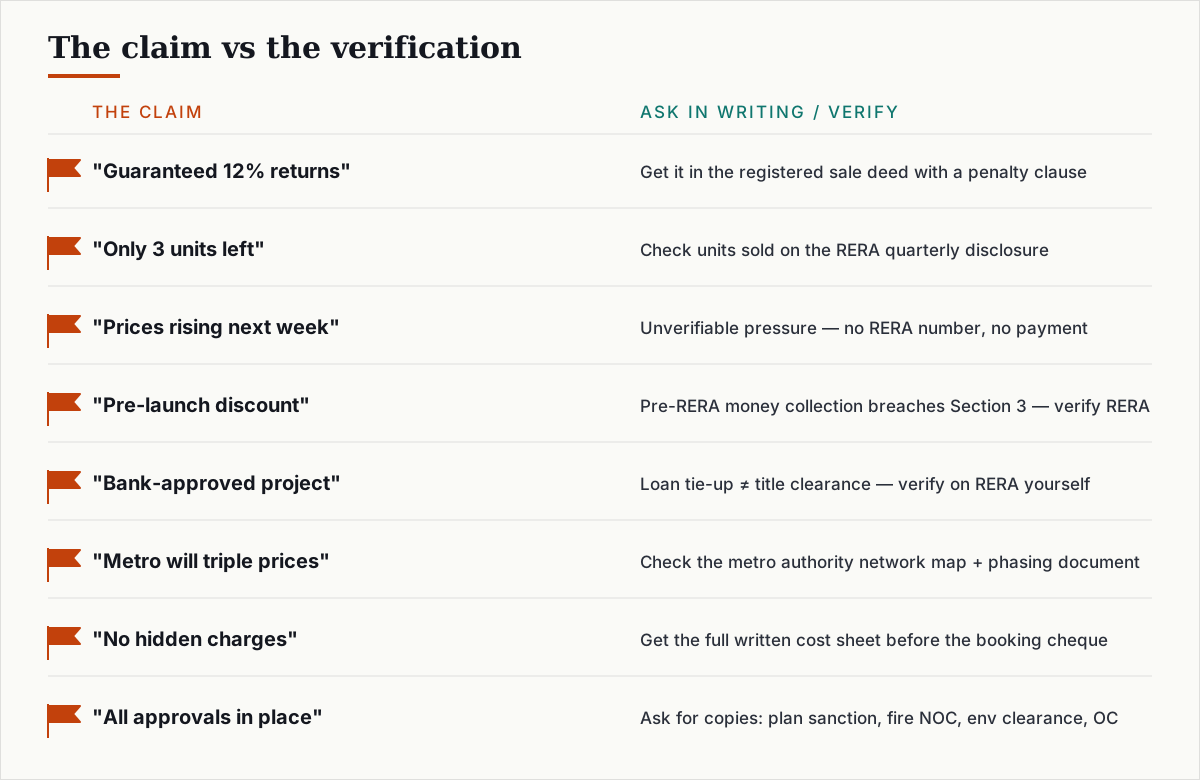
A property sales pitch is not a document. Nothing said in a site visit, a brochure, or a WhatsApp message is legally binding unless it appears in the registered sale agreement. The eight claim types below each have a documented pattern of not surviving contact with official records. For each one, the verification action is specific and free.
1. 'Guaranteed returns of X percent per year'
Guaranteed return schemes on real estate have been flagged by SEBI, RERA authorities, and consumer courts across multiple states. An unregistered scheme promising guaranteed rental or capital returns may fall under the definition of a collective investment scheme regulated by SEBI, or it may simply be a contractual promise with no asset backing. The verification action: ask for the guarantee in the registered sale agreement, with a specific penalty clause and a named guarantor. If it appears only in a term sheet or a side letter, it is not a guarantee — it is a claim.
2. 'Only 3 units left — prices go up next week'
Artificial scarcity and time pressure are standard sales psychology, not information. The RERA project registration lists the total number of units and units sold as of the last quarterly update. Check the portal. If 'only 3 left' does not correspond to the portal's unit count, you have a data point. The 'price increase next week' claim is unverifiable by definition — and frequently repeated on the next visit too.
3. 'Pre-launch — get in before approvals come through'
Collecting money before RERA registration is obtained is prohibited under Section 3 of the RERA Act. A builder who invites bookings on the strength of a 'pre-launch' offer before the RERA number exists is technically in violation of the Act. Verify: go to the state RERA portal before paying anything. If there is no registration number, there should be no booking amount. A token 'expression of interest' may not be legally a booking, but your money is still at risk.
4. 'Bank-approved project'
This phrase means a bank has tied up with the builder for home loans to buyers — it is a commercial arrangement. It does not mean the bank has verified the project's title, the builder's track record, or the project's completion risk. Several projects with bank tie-ups have stalled or been cancelled. The phrase is a marketing claim, not a due-diligence clearance. Verify the project independently on the RERA portal regardless of which bank has a 'tie-up'.
5. 'The metro will triple prices here'
Infrastructure-driven appreciation is real — but only for infrastructure that is completed, operational, and within practical walking distance. A metro station proposed in a 15-year development plan, not yet sanctioned, not yet tendered, does not triple prices on a reliable timeline. Verify: check the relevant metro authority's official network map and project phasing document. 'Phase 3 extension' that has been pending approval for four years is not the same as a station opening next year.
6. 'All approvals in place'
This claim requires a document list, not a verbal assurance. The approvals that matter: building plan sanction from the municipal authority, fire NOC, environmental clearance (for projects above the threshold), layout approval from the planning authority (for plotted developments), and — for occupied or near-complete buildings — the occupancy certificate. Ask the sales office to produce copies. If the response is 'we will share later', that is not 'all approvals in place'; that is a deferred verification problem.
7. 'No hidden charges — what you see is the final price'
Ask for a written cost sheet before paying the booking amount. Standard additions to the advertised base price: preferential location charges (PLC) for higher floors or better orientation; club membership fee (typically non-optional); maintenance deposit or corpus fund (one to two years of maintenance in advance); car-parking charges; infrastructure development charges (IDC) or external development charges (EDC) applicable in some states; and GST at the applicable rate for under-construction units. None of these are 'hidden' once disclosed — but they are frequently not disclosed until after the booking cheque is written.
8. 'Possession in 18 months — it's in the agreement'
Possession timelines in sale agreements are frequently aspirational. Under RERA, a builder who misses the agreed possession date owes the buyer interest on the paid amount at the prescribed rate, or — if the buyer opts — a full refund with interest. That remedy is real but pursued after the delay has occurred. The useful verification step is prospective: check the builder's RERA record on previous projects. If possession was delayed by 12 to 24 months on their last three completed projects, that pattern is predictive. The current project's '18 months' may be a best-case estimate with a two-year buffer unstated.
More from Red-Flag Guides
Property fraud in India: the document check that catches each common scam
India's property frauds — GPA sales, double registrations, forged khata, fake NRI owners, unapproved layouts — each fail one document check buyers skip.
Carpet area vs super built-up area: what you are actually buying
Carpet area vs super built-up vs built-up area: what you actually own, how builders inflate the number, and what RERA now requires them to state.
How to choose the right apartment in India: the buyer's checklist
A verification-first checklist for picking a flat — RERA status, OC, carpet area, builder track record, locality signals, payment schedule and title chain.