Plot vs apartment vs villa: an investment evaluation framework
Plot vs apartment vs villa: how the three compare on appreciation, rental income, risk and liquidity, and how to choose for your goal.
PropWatch Editorial7 min read
The question 'which is better — plot, apartment, or villa?' has no answer without knowing the specific property, the location, the buyer's risk profile, and the financing structure. What follows is a framework for scoring the trade-offs yourself. It does not produce a verdict; it produces an informed comparison.
Dimension 1 — Title and legal risk
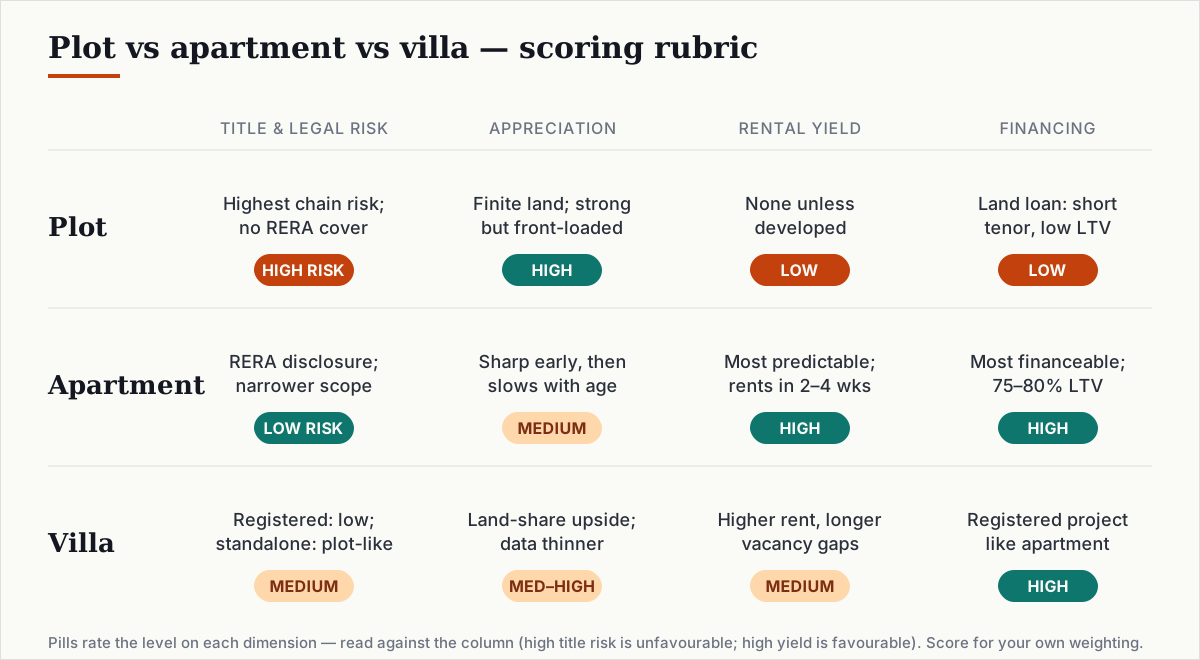
Plots carry the highest title-chain risk of the three categories. A plot purchase involves verifying the land's revenue records (patta, khata, mutation), the parent title chain going back at least 30 years, agricultural-to-non-agricultural conversion status, layout approval from the planning authority, and the absence of court orders, government notifications, or revenue encumbrances. None of this is covered by RERA — a plot inside a RERA-registered plotted layout still requires independent title verification, and plots outside a registered layout carry the full exposure without any statutory framework.
Apartments in RERA-registered projects have statutory disclosure — the promoter's title is declared at registration and any encumbrance must be disclosed. That does not make the title perfect, but it narrows the verification scope. Villas in a registered project share this advantage; standalone villas on independently acquired land are closer to plots on the title-risk dimension.
Dimension 2 — Capital appreciation
Plots in well-located areas of a growing city have historically delivered strong appreciation, because they are finite — land is not manufactured — and because the buyer can develop or redevelop them. That upside is real but front-loaded with development risk (approvals, construction, cost overruns) if the buyer intends to build. A plot in a semi-developed area with uncertain connectivity and infrastructure may appreciate slowly or not at all while the surrounding market moves.
Apartments appreciate in line with the building's age trajectory: a new apartment typically appreciates sharply in the first five years post-possession, then more slowly as the building ages and newer inventory enters the same market. Villas can outperform apartments in appreciation within gated communities where the land component is a meaningful share of the asset value, but the data is thinner and more location-specific.
Dimension 3 — Rental yield
Apartments generate the most predictable rental income of the three. Demand from urban tenants — professionals, families, corporate lessees — concentrates in apartment stock. A 2BHK or 3BHK apartment in a well-connected micro-market can typically be rented within 2 to 4 weeks of listing. Gross yields range from 2.5 to 4.5 percent depending on city and micro-market, per market data from Anarock and similar aggregators.
Villas attract a narrower tenant profile — typically senior executives, expatriates, or corporate tenants — and command higher absolute rents but are harder to keep tenanted continuously. Vacancy periods between quality tenants can be longer. Plots generate no rental income unless developed, and development adds construction risk and capital outlay.
Dimension 4 — Financing availability
Apartments in RERA-registered projects with valid OC are the most financeable residential asset in India. Every scheduled bank offers home loans against them; loan-to-value ratios of 75 to 80 percent are standard; interest rates are relatively competitive. Villas in registered projects are broadly similar. Plots are a meaningfully different story.
Most banks do not offer home loans for plot purchase alone. A loan for a plot is classified as a land loan, with shorter tenors (typically up to 15 years vs 30 years for home loans), lower LTV ratios (typically 60 to 70 percent), and higher interest rates. Some lenders offer a combined plot-plus-construction loan, but the construction component attracts its own conditions. A buyer who intends to finance a plot purchase needs to verify the available financing structure before committing — the assumption that 'it's like a home loan' is incorrect.
How to use the framework
Weight the four dimensions by what matters most to you. A buyer who needs regular rental income and low administrative burden should weight rental yield and financing heavily — apartment will score best. A buyer with a long time horizon, capital for independent development, and tolerance for title-verification complexity may weight appreciation and title risk differently and find a well-located plot scores adequately for their purposes. Neither outcome is correct in the abstract; both are legitimate if the weights are honest.
More from Red-Flag Guides
Red flags in a property sales pitch: 8 claims to verify before you sign
Guaranteed returns, artificial scarcity, pre-launch without approvals — 8 generic claim types in property sales and exactly what to ask or check for each.
Ready-to-move vs under-construction in India: a decision framework
Not which is better — but the actual trade-offs: GST differential, possession risk, pre-EMI dead interest, delay cost. A risk-first framework for Indian buyers.
Carpet area vs super built-up area: what you are actually buying
Carpet area vs super built-up vs built-up area: what you actually own, how builders inflate the number, and what RERA now requires them to state.