Ready-to-move vs under-construction in India: a decision framework
Not which is better — but the actual trade-offs: GST differential, possession risk, pre-EMI dead interest, delay cost. A risk-first framework for Indian buyers.
PropWatch Editorial7 min read
The question is not which category is better. It depends on your risk tolerance, your current housing situation, your loan structure, and whether you trust the specific builder you are considering. The framework below maps the trade-offs, not a verdict.
The GST differential
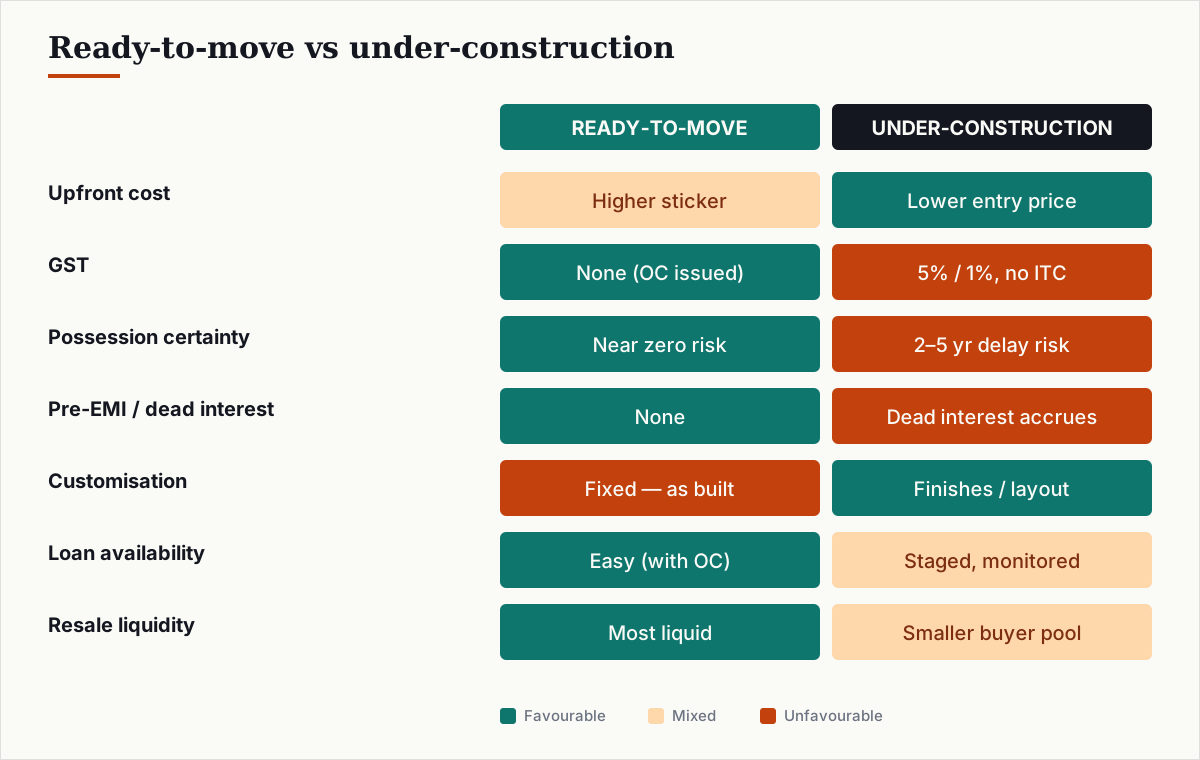
Under the GST rules notified by the Ministry of Finance, a ready-to-move-in apartment with a valid occupancy certificate at the time of sale is not subject to GST — the transaction is treated as a sale of immovable property, which falls outside the GST ambit. An under-construction apartment, or any flat sold before the occupancy certificate is issued, attracts GST: 5 percent of the agreement value for units priced above ₹45 lakh, and 1 percent for units under the affordable housing threshold, with no input tax credit for the builder.
On a ₹1 crore under-construction flat, that is ₹5 lakh in GST the buyer pays that does not go into the builder's construction costs or your property value. On a ready-to-move equivalent unit, the saving is immediate. Buyers who compare prices without netting out the GST differential are making an apple-to-orange comparison.
Possession risk — the central asymmetry
A ready-to-move flat is handed over at or shortly after registration. The possession risk is near zero on the timeline. An under-construction flat carries two to five years of construction exposure — the builder may delay, change specifications, run into funding problems, or face a regulatory hold-up on the occupancy certificate. RERA provides a remedy for delay: interest on the amount paid, or refund. But the remedy is pursued after the damage — months or years of waiting, litigation costs, and the opportunity cost of money parked in a stalled project.
If your immediate housing situation requires certainty — a lease ending, children's school admissions, a move from another city — the ready-to-move option eliminates the single largest risk in the transaction. If you can absorb two to three years of construction time and price in that uncertainty, under-construction offers a different value proposition.
Pre-EMI and dead interest
When you take a home loan for an under-construction property, the lender typically disburses the loan in tranches linked to construction milestones. You pay interest on the disbursed amount during construction — this is the pre-EMI. The full EMI (principal + interest) begins only after possession. The pre-EMI is purely dead interest: it builds no equity, reduces no principal, and earns no housing benefit because you are still paying rent elsewhere.
On a ₹60 lakh loan disbursed over 24 months of construction at a 9 percent rate, the pre-EMI interest over that period can amount to ₹5.4 to ₹6.5 lakh, depending on disbursement pace. Add the GST on the purchase price. Add the rent you continue paying while the flat is being built. The true cost of an under-construction flat at any quoted price is meaningfully higher than the sticker.
Customisation and loan availability
Under-construction projects offer one genuine advantage on the product side: the buyer can often choose flooring, kitchen finishes, or electrical layout while construction is underway. Some builders offer structural modifications at an early stage. Ready-to-move units are fixed — what you see is what you buy, and changes require post-possession renovation.
Home loans for ready-to-move apartments are straightforward: the bank values the existing structure, checks the OC, and disburses. For under-construction, the loan is disbursed in stages, the bank monitors construction progress, and any regulatory issue with the project can delay disbursement. A ready-to-move unit in a building without OC — common in the secondary market — may face the same loan-approval difficulty as under-construction. OC status matters more than occupancy status for loan purposes.
Resale liquidity
Ready-to-move apartments in buildings with OC are the most liquid asset class in residential real estate. A future buyer can get a home loan easily, take possession immediately, and verify the property's condition in person. Under-construction units can be resold, but the buyer pool is smaller, the assignment process requires the builder's consent under most agreements, and the transfer may attract GST and stamp duty depending on how the assignment is structured. Resale liquidity is worth pricing into the decision if there is any chance you will need to exit before you intend to.
More from Red-Flag Guides
Carpet area vs super built-up area: what you are actually buying
Carpet area vs super built-up vs built-up area: what you actually own, how builders inflate the number, and what RERA now requires them to state.
How to choose the right apartment in India: the buyer's checklist
A verification-first checklist for picking a flat — RERA status, OC, carpet area, builder track record, locality signals, payment schedule and title chain.
Plot vs apartment vs villa: an investment evaluation framework
Plot vs apartment vs villa: how the three compare on appreciation, rental income, risk and liquidity, and how to choose for your goal.